Why rapid software testing matters with Ryan Bevens
Ryan Bevens has spent nearly two decades in software testing across the US and New Zealand. Through his relationship with global testing expert Michael Bolton, Salt is bringing DevelopSense's Rapid Software Testing (RST) workshop to Australia and New Zealand in 2026. Ryan shares his career highlights and explains why he believes rapid software testing is important.
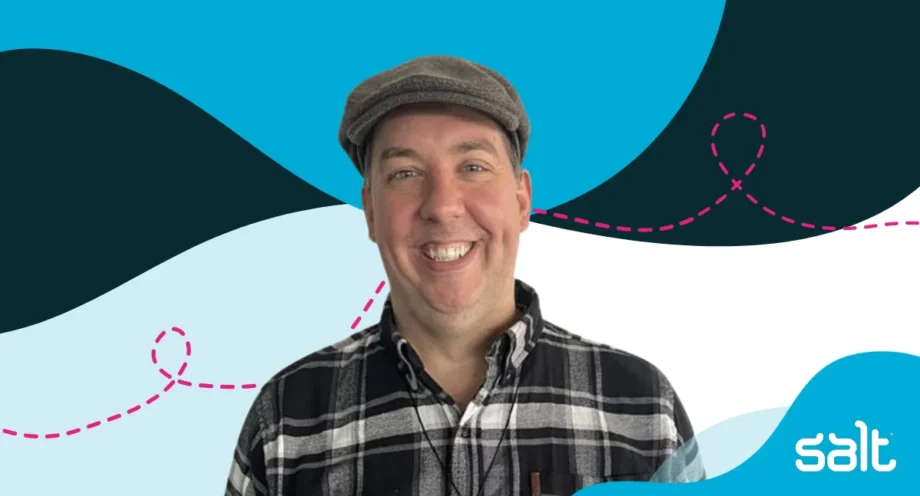
In this Expert Insights conversation, Chlöe Dickie, Salt’s APAC Marketing Manager, speaks with Ryan Bevens, Managing Consultant – Technology, in Salt’s Auckland office. The testing community knows Ryan as the Reluctant Recruiter, while many in the recruitment community will recognise him as the 2025 RCSA Rising Star award winner. With nearly two decades of experience in software testing roles across the US and New Zealand, including Test Manager roles at two Fortune 50 companies, Ryan brings depth of experience, perspective, and a well-honed sense of humour to his craft.
It’s through Ryan’s relationship with global testing thought leader Michael Bolton from DevelopSense that Salt is hosting a series of Rapid Software Testing (RST) workshops in Australia and New Zealand in early 2026. Before we dive into the workshop itself, let’s get to know Ryan a little better.
Register your interest in the eventRyan, you’ve had a fascinating career journey. How do you explain your path when people ask how you got here?
I got tired of digging graves for a living! But, seriously, I was a wanderer who had ended up in the mortgage industry. I started in testing when a company wanted someone who could explain mortgages, and I fit the vibe. They said, “We’ll teach you testing,” and I said, “Sure, why not?” Suddenly, I blinked, and 17 years later, I’m managing test teams and discussing risk analysis with CEOs of Fortune 50 companies. So yeah – not exactly linear.
You’re now four years into your transition into a recruitment consultant – what was the lightbulb moment that made you say, “Yes, I’ll try this?”
I applied to a job I didn’t think I applied to and those recruiters were good at their jobs! Then, ultimately, it was the fact that my ‘why’ is helping people. I enjoy mentoring and coaching. I enjoy seeing other people succeed. And if I can be part of someone’s success, it fills my proverbial cup.
How can you do that as a recruiter?
By being there for candidates and, often, my clients as well. I have real-world conversations about the tech world and testing, and help people think through issues and solve problems. They aren’t the problems I would have necessarily solved in my previous life, but they are still fixed issues – there just isn’t usually code involved!
What are your favourite parts of the craft of recruitment?
There are two things I find incredible and unique to the role of a recruitment consultant. The first is, obviously, when I help an exceptional individual find work and a client solve a talent problem.
The second is something I didn’t realise I’d been doing until I had been in recruitment for a while; I’ve been able to invest time in attending and coordinating events to both create and support the testing community. Over the last few years, I’ve helped organise and host events for the Ministry of Testing, spoken at conferences, and brought world-class trainers and thought leaders to New Zealand.
Whom have you brought to New Zealand, and how has this benefited the testing community at large?
For the last couple of years, I have brought one of my favourite people, Michael Bolton (no, not that one), to New Zealand, and I’ll be bringing him back early next year – to Australia and New Zealand. Michael is a world-renowned test guru, and next year he will be teaching an AI in Testing course and sharing insights from his new book Taking Testing Seriously, co-authored with James Bach.
You’ve taken one of Michael’s Rapid Software Testing workshops yourself – what was a highlight?
It was the first time someone articulated the ‘why’ of testing in a way that made perfect sense and just ‘clicked’. Michael helped me verbalise and justify the value of what I was doing – not just what I tested, but why, and why it matters. It gave me language to justify testing decisions, and honestly, that’s huge. It also made me feel like less of a professional bug-hunter and more of a thinking investigator. Like Sherlock, but slightly more caffeinated and with fewer British accents.
Register your interest in the eventFor anyone (like a marketer) who hasn’t heard of rapid software testing – or thinks it may be ‘just another training’ – how would you describe it?
Okay, imagine a testing course – but remove the boredom. Remove the PowerPoint slides with clip art. Remove the ‘we’ve always done it this way’ mentality. Remove the specific set of tools.
The workshop we’re bringing to Australia and New Zealand – RST: Testing, Automation, and AI – is not your standard ‘testing methodologies’ seminar. It’s an intensive, three-day thinking workout that fundamentally shifts how people approach quality. Instead of reducing testing to checklists or automated scripts, Michael teaches testing as a process of reasoning, inquiry, and discovery – learning about a product through active exploration and experimentation.
When you attend one of Michael’s workshops, you get to dive into automation from a critical perspective: making sure it genuinely adds value, when it introduces hidden cost or risk, and most importantly how to tell the difference. People will get to explore how testing must and will evolve in a world where AI can generate output that’s surprising, incorrect, inconsistent, or misleading – and you’ll learn how to probe, challenge, and evaluate that output in a way that is meaningful to users. Through exercises, dialogue, and live demonstrations, they’ll build confidence in how to think, how to test, and how to communicate that thinking to stakeholders and peers.
In my class I saw the value, not just for testers but for developers, BAs, or anyone leading these teams. This workshop supports people working smarter and more collaboratively, while elevating quality across your entire organisation.
Earlier, you shared how Michael helped shift your thinking – what did you take from his teaching on a deeper level?
I walked away with a greater sense of why we test – not just how. Michael taught me how to qualify and quantify the work I was doing and how to explain it to others in a way that actually made sense. Before that, I knew I was doing valuable work, but I wasn’t always great at communicating that value. The workshop gave me vocabulary. It helped me demonstrate why testing matters, not just to testers, but to the organisation. Obviously, as a tester, this is game-changing. However, even someone who works alongside software testers (or as a recruiter) can learn invaluable lessons!
To my point earlier, we had several developers and a business analyst in the room – and they found the course incredibly valuable. They got an inside look at how testers think. And once you understand that, suddenly, collaboration gets easier. They started saying things like, “Ohhh… I get it now – here’s how I can support that work, not just throw tickets over the fence.”
Honestly, it was the best class I’ve ever taken in relation to software testing. It made me a better tester – but also a clearer thinker and communicator – and that’s why I’m so passionate about ensuring as many people as possible can learn from Michael.
For someone thinking, “This sounds interesting, but I’m busy – should I actually attend?” – what would you say?
I would say, do you want to think better, not just test better? If you’ve ever sat in a meeting and thought, “I know this is the right call, but I don’t know how to explain it,” – this workshop will solve that by giving you language, logic, and confidence.
Also, it’s fun. And we don’t get enough fun in testing.
Meet the instructor
Michael Bolton isn’t just an instructor – he reshaped how modern testing is approached globally, and the rapid software testing (RST) methodology is built on the foundational belief that testing is not just executing checks or scripts, but evaluating a product by learning about it through experience, exploration, and experimentation.
In the three-day RST: Testing, Automation, and AI workshop, Michael will help you expand your understanding of testing beyond traditional output checking by demonstrating how the creative use of tools – often inexpensive ones – can help probe data and reveal unseen behaviours in a product. You will learn to assess the cost versus the value of tools and how certain forms of automation can either empower or mislead testing efforts.
Importantly, the workshop is not affiliated with any commercial tool vendor. Tools are used, but not sold; discussed, but not promoted. Michael will teach you how to think critically about automation promises, and focus on building human judgement – not tool dependency. By the end of the course, you will walk away with the ability to evaluate tools, communicate testing value, and skillfully apply testing in environments influenced by automation and AI.
One of the unique strengths of the workshop is its inclusivity of technical backgrounds. Whether you’re a coder or not, you’re supported. While you won’t learn how to code, you will learn how to communicate and collaborate effectively with those who do.
The Salt tech, testing & engineering community
Salt is proud to support the testing, engineering, and wider tech communities by facilitating access to globally recognised expertise. This workshop is designed to support professional development, strengthen technical capability, and build shared understanding and language around quality. These workshops are also a rare opportunity to learn directly from Michael – in person – right here in Australia and New Zealand. If you’re based in Auckland, Christchurch, Melbourne, or Sydney and interested in attending the three-day RST: Testing, Automation, and AI workshop in March 2026, register your interest here, and we’ll be in touch when tickets go on sale.
Michael is also available to deliver private sessions for Australia and New Zealand-based organisations throughout March 2026. These sessions are fully customisable to your organisation and context and can be arranged at times that work for your team and schedule. If you’d like to learn more – or ask Ryan how private sessions can benefit your team or organisation – connect with him.