AI does the work, people judge it
AI agents are taking over execution. Judgement isn’t moving. What founders, CTOs and product leaders told us at our latest AI Breakfast, and what it means for how you hire.
Four tables. Four different questions on work, organisation, trust and economics. All ending up in the same place.
Every table had been asked a version of the same question: who’s actually doing the work? That was the brief for AI – Served Fresh, our third invite-only breakfast in Dubai with Founders, CTOs, CPOs and engineering and product leaders,co-hosted by Tiago Henriques, Head of AI/ML Technology Practice, Google Cloud EMEA and the MENA Leaders community.
The room was at Salt Dubai, but the conversation wasn’t local. The same questions are coming up in our conversations with hiring leaders worldwide: what to hand to the agents, who own the call, and what the team looks like afterwards.
The answer was clear. Execution, from research and code to first drafts and support tickets, is moving to AI agents. Judgement isn’t. What stays human: the taste to know what good looks like. The authority to make a call that can’t be undone, and the accountability to own the mistake.
That is now the scarce resource that most organisations haven’t redesigned themselves around it yet.
From doing to judging
Several people compared AI to Excel. Something that stops being a specialist skill and becomes the default way work gets done. Across coding, research, marketing and customer operations, the room broadly agreed that execution should be close to fully automated. Research, first drafts, initial code, prototyping and market testing. Speed and cost make the case on their own.
What changes is the human job. In one customer support operation, the people who remain no longer answer tickets. They assess what the AI handled and judge the outcome.
Not everyone agreed on how much that judgement matters. One side argued that agents lack taste and architectural foresight, so without a human owner, quality drifts. The other said messy work is a human habit too. If an agent reaches the objective faster, a little internal sloppiness is a price worth paying.
The constraint is no longer how much work a team can do. It’s how much good judgement it can apply to what the agents produce.
Smaller, flatter, blurrier
If one person with five agents can do the work of a team, the team changes shape. On the day we were given live examples:
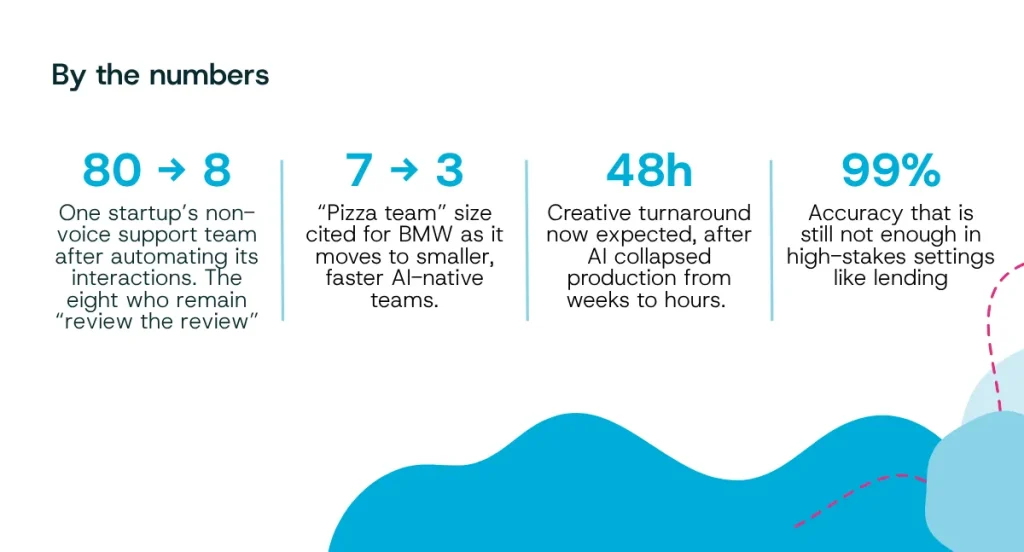
One startup automated all of its non-voice support interactions and went from 80 people to eight. The eight who remain handle exceptions and “review the review”. BMW was mentioned, moving from seven-person “pizza teams” (Amazon’s idea of a team small enough to feed with two pizzas) to teams of three to gain agility.
Role boundaries are collapsing too. Engineers are picking up design, infrastructure and product research, because AI handles the baseline technical work.
Middle management was seen as the most exposed. Emailing, synthesising data and creating content are exactly what agents do well. Several leaders said they’re already planning smaller, AI-native leadership layers. The managers who stay won’t be the ones who coordinate the work. They’ll be the ones who can judge it and teach others to.
Junior roles were the closest the room came to consensus. Nobody wanted to remove them. Cut the entry level today and in five years there’s no one left who learned what good looks like. The job is to redesign them, so the next generation learns to manage AI systems rather than compete with them.
Before you cut a role, ask what judgement leaves with it.
The one-way door
Every table found the same split. Bulls ready to automate almost everything, and a more cautious group worried about liability.
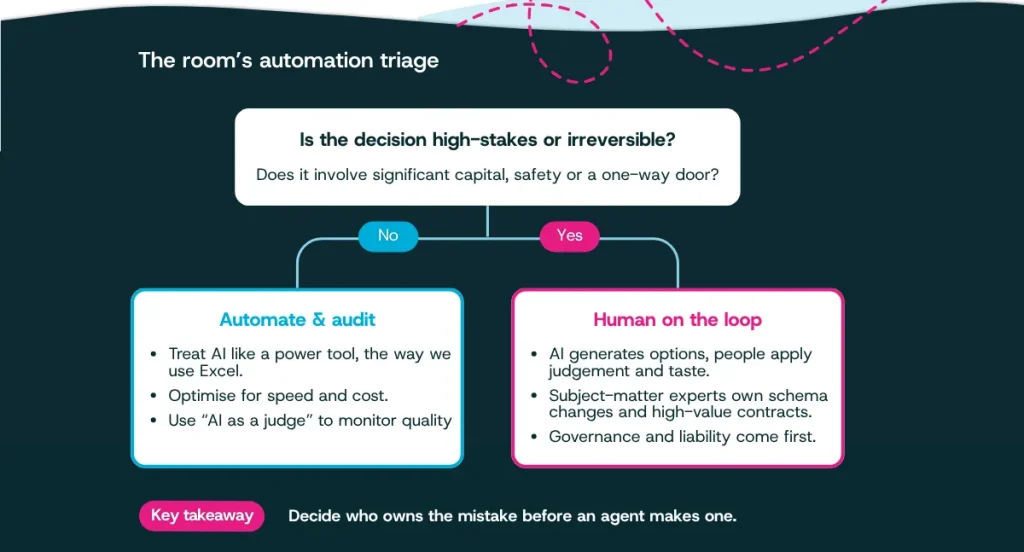
When discussing trust, it depended on the stakes. Confidence was high for meeting minutes, research and itineraries. It drops sharply for investing money or analysing medical records. The test the room kept coming back to was simple: is this a one-way door? Once it’s done, can you undo it?
The biggest open question of the morning was who made the mistake. With no or little legal precedents in most markets for AI-driven failures, organisations are defaulting to strict governance. And checking the output is still the bottleneck. In lending, 99% accuracy isn’t good enough. One wrong decision in a hundred is a regulatory and reputational problem.
Map your one-way doors, then put a named, accountable person behind each one. That’s a hiring decision before it’s a governance one.
The economics nobody can measure yet
We asked every table for one workflow where AI had genuinely changed the economics of the business. The answers pushed back on the idea of AI as a simple cost-saver.
Headcount savings are easy to point to. The costs are quieter: token and infrastructure spend, and the institutional knowledge that leaves with the people who held it. Most organisations still can’t measure the revenue AI actually creates, because much of today’s adoption is just doing the same thing faster.
There was real concern that cheaper can mean worse. Automated service done badly stops being a solution and becomes a barrier between a company and its customers. The better version uses AI to move service from reactive to proactive, and judges success by customer satisfaction, not speed.
Count what leaves with the people, not just the salaries. Institutional knowledge never shows up in the headcount saving.
Production is cheap. Taste isn’t.
Advertising showed most clearly what happens to an industry once execution gets cheap. Production that used to take weeks now takes hours. Clients expect work back in 48 hours, and they’re cutting retainers because the making no longer justifies the fee.
What’s left to pay for is judgement. As AI-generated content floods every feed, audiences are drifting back towards human imperfection: raw, unedited mobile video is outperforming polished work. Anyone can produce now. Knowing what will land, and having the nerve to choose rough over polished, is the skill that’s scarce.
The agencies holding their value aren’t selling output. They’re selling the call.
For hiring leaders: the creative hire worth fighting for now is the one who can tell you what to make and why, not the fastest producer.
Our line to end on
At the first breakfast, people asked what AI could do. By the third, the question had become what we’re prepared to hand over? Who stays accountable and what does the organisation looks like when the doing is no longer the hard part?
“Execution is becoming a commodity. Judgement, taste and ownership are not.”
If judgement is now the scarce resource, it’s also what you need to hire for. Salt places AI and digital transformation leaders across the Middle East, Asia Pacific, Africa and Europe, from first AI hire to scaling a global team.
If the job is now judging the output, hire for people who can tell good from good enough. Ask candidates to critique an AI draft, not just produce one.
Read: Salt'S Essential AI Talent Report