Essential AI talent report
AI is transforming every industry, and the organisations winning right now are those investing in the talent, skills and structures needed to use it.
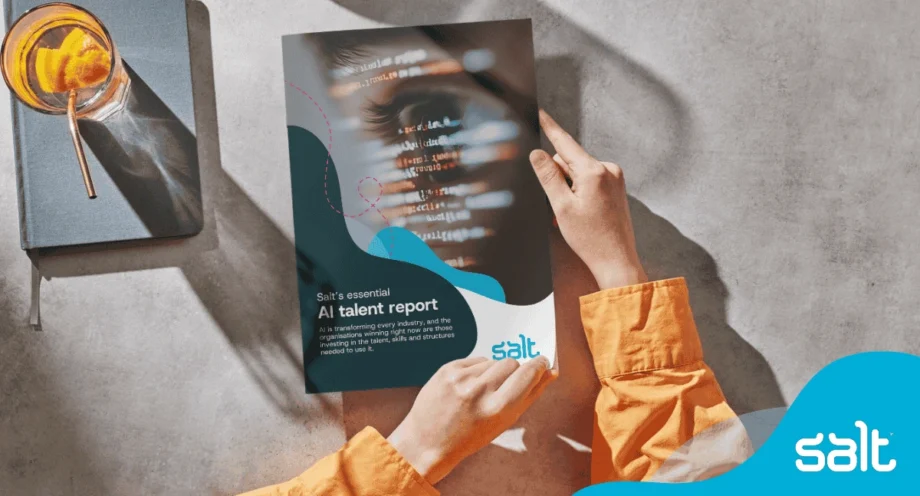
AI is advancing, and the differentiator is talent. As continued demand for specialised AI talent advances globally, organisations need to build the right capabilities and structures to keep pace. How? By investing in human-centered AI readiness.
TL;DR
Demand for AI capability is surging globally, with roles expanding beyond engineering into architecture, governance, product, and design. With growth in AI literacy demand and businesses shifting from experimentation to execution, upskilling and securing specialised talent isn’t optional, it’s the determining factor in who leads the next decade of innovation.
Download the Report directlyTechnology is creating a constant catch-up challenge
Organisations adapting best are those pairing strong technical foundations with dedicated AI talent. So that they have people in place who can turn new capabilities into real outcomes.
As AI becomes embedded across operations, it’s reshaping business models, redefining value chains, and transforming the expectations of both customers and employees.
Demographic trends, persistent skills gaps, and evolving labour markets are creating pressure on organisations to act with agility. The World Economic Forum notes that demand for AI literacy skills surged by 70% between 2024 and 2025, reflecting the critical need for AI talent across industries.
We’ve looked at the trends in our own data, based on live roles in the past 12 months, mapping AI‑specific hiring insights to the global trends shaping AI talent.

In a market that has changed, and continues to do so at pace, do you have a team who can respond and adapt? Jaqui Barratt, CEO Salt APAC
AI talent trends
Why 57% of organisations are choosing contract talent first.
Organisations are still in exploration and early-scale phases, with 57% favouring contract AI talent to support programmes, pilots, and time-bound initiatives before committing to permanent structures.
There are several layers to these choices businesses make. First, contract talent allows organisations to access highly specialised skills – prompt engineers, ML ops practitioners, AI ethics advisors – that may only be needed for the duration of a specific initiative.
The AI landscape itself is moving fast enough that the skills required today may look quite different in just a year’s time. Contracting gives organisations the flexibility to refresh their talent mix as the technology evolves.
Most in-demand role families for AI
in our global network
Architecture
- Chief AI Architects
- Creative AI Architects
- Solution Architects
Engineering
- Gen AI Engineers
- Lead Data Engineers
- AI Engineers
Governance
- Privacy Enablement
- AI Risk roles
Product & Marketing
- AI Product Designers
- Marketing AI Automation
Industries actively hiring AI talent in our network
- Financial Services & FinTech
- Consulting
- Creative & Media
- SaaS & Cybersecurity
- Fitness & Wellness
Where we’re seeing the most AI hiring activity
- UK & Europe
- MENA
- Sub-Saharan Africa
- Australia
AI hiring is broadening beyond core engineering. Reinforcing that successful AI adoption requires structural, ethical, and human-centred capability alongside technical depth.
(Source: Salt internal dataset; sample size: 100+ live roles. Included for transparency)

61% of CEO’s are concerned about AI-related cyber risks; escalating threats, tightening global privacy regulations, and rapid AI-driven innovation have made advanced security a top priority.
The future isn’t AI.
It’s deeply human.
When we talk about AI, we talk about the people behind it and in front of it. Because every transformation succeeds or fails on both business and people readiness.
Chief strategy officers rank AI commercialisation and emerging technologies (72%) alongside talent shortages and workforce transformation (24%) as the most impactful trends shaping the next five years.
The World Economic Forum reported that as AI capabilities advance, businesses face growing competition to innovate while adapting workforce strategies in near real time. Organisations that prioritise AI talent, including developing, hiring, and reskilling employees, are better positioned to use AI’s potential, stay competitive, and navigate the uncertainties.
AI’s structural takeover globally: venture and talent
Artificial intelligence is becoming the central engine of global venture activity, reshaping where capital goes, where companies form, and where talent migrates. Pitchbook’s latest data shows a rewiring of the innovative economy across Europe – while parallel shifts in California and APAC confirm this is a global realignment, not a regional one.
In 2025, AI-related deals represented 35.5% of all European VC value, totaling €23.5B.
Investors and founders now differentiate between pure AI companies, where the core IP is the model, and AI-Enabled companies where AI features augment existing legacy products. This distinction marks a shift in talent requirements. Companies must now hire for domain-specific AI expertise.
Across the world, the message for organisations and candidates is AI talent is now globally contested.
- Your competitors are not in your city or country, they are global.
- Technical depth is becoming a universal requirement.
- Hiring strategies must become global by design.
Upskilling in AI in no longer optional; it is the only sector seeing a structural shift toward long-term dominance.
Europe’s AI boom is concentrating in a handful of powerhouse hubs
Each scaling demand for world‑class technical talent. The UK continues to lead with a thriving IT and AI ecosystem, illustrated by major late‑stage raises such as Synthesia’s £149.4M funding round.
Germany and France are appearing as strong AI talent corridors. Germany’s surge, marked by Startup Black Forest Labs’ €259.4M raise, signaling a maturing market. While France’s position is cemented by Mistral AI’s €1B+ round in 2025.
Together, they’re driving some of the continent’s fiercest competitions for specialised AI expertise.
California as the world’s most concentrated AI talent market
Parallel to Europe’s growth, California is still an epicenter for AI job creation and innovation. In 2025, the San Francisco Bay Area experienced a 24% surge AI skilled tech talent, even as tech hiring slowed. It also continues to lead US AI hiring, with nearly one fifth of all national AI job postings. California’s hyper density makes it a leading indicator for what global AI labour will resemble competitive and saturated innovation.
APAC as the fast accelerating AI capability region
APAC has become a quietly powerful engine, with rapid adoption and capability building. Employees in Asia Pacific are adopting generative AI tools faster than anyone else globally, but like everywhere, employees note that their businesses are experimenting with AI agents, but a small minority feel they understand the tools well. Signaling education and skills gaps.
The AI hiring is fueled by Smart Manufacturing, Robotics, MedTech & Healthcare, industrial automation and Fintech and Banking. These industries require applied AI-ability, giving APAC a distinctive competitive advantage in practical, production-grade AI engineering. Making APAC a strategic AI Capability hub.
The unspoken challenges of AI hiring
AI Governance is moving centre stage: The Salt hiring insights point us to the rise of trust, privacy, and risk roles as AI scales.
Architecture is a critical bottleneck: Demand for Chief AI Architects and Solution Architects roles show us a demand for end‑to‑end design, integration, and value‑case ownership.
Applied GenAI talent is mainstreaming: Demand for Generative AI Engineer and OpenAI Consultants show enterprises are moving from POCs to production.
Human‑centred design matters: Conversational AI Product Designer roles are spotlighting usability, safety, and adoption as determinants of ROI.
Across industries, leaders align one key challenge: while the tools and technology are widely available, organisations consistently lack the culture and confidence to use them to their full potential.
How to hire for tech and AI readiness
Across our work with clients globally, we’re seeing two consistent truths:
1. Transformation only works when people are ready.
2. Culture and capability must evolve faster than technology.
AI is a rapidly advancing field, and we expect the demand for AI-related skills and ability to grow exponentially across the tech industry and beyond.
The developments in AI’s capabilities also increase demand for existing roles, such as Machine Learning Engineers and Data Scientists. For the tech sector, more than anywhere, it’s important to make sure teams are prepared for the rapid implementation of AI tools and get up to speed with new ways of working.
Skills-based hiring and finding AI competence is therefore key, as qualifications in AI are still relatively rare.
Our recent guide to AI for business leaders offers additional insights into the new roles appearing due to digital advancements.
The AI talent behind transformation
Artificial Intelligence (AI) is transforming industries at pace, and behind every breakthrough are the visionaries pushing the boundaries of what’s possible. Our 10 Game-Changers in AI You Need to Know Right Now, showcases just some of the people shaping the future.
Technology alone doesn’t drive change
Organisations looking to stay ahead must invest in the right skills to harness technological potential. Growth is no longer confined to the technology sector alone. Education, professional services, financial services, and utilities are all rapidly expanding their AI capabilities.
Organisations across industries are competing fiercely for AI talent, making it critical to hire, develop, and keep the right people to fully use AI’s potential.
AI hiring: The shift toward senior talent and scaled delivery
Our 2025 AI briefs reveal a market shifting from experimentation to execution.
Role seniority: Demand is being concentrated at mid-to-senior levels (Lead, Director, Chief), signaling a clear move away from AI proof-of-concepts toward experienced operators who can industrialise AI and deliver commercial outcomes.
Operating model: The mix of 57% contract vs 43% permanent highlights a dual-track strategy. Organisations are using contract talent to accelerate delivery and de-risk transformation, while securing permanent hires to embed capability, governance, and long-term ownership.
Timing and urgency: Demand remained strong through Q4 2025, particularly October–December, showing organisations are racing to secure scarce AI talent ahead of 2026 planning and budget cycles.
AI talent is no longer a future bet. Businesses are investing now in leadership, speed, and stability to ensure AI moves from promise to production at scale.
Critical roles and capabilities businesses are prioritising in AI
Machine Learning Engineers: Build and optimise algorithms that power predictive models, requiring expertise in Python, TensorFlow, PyTorch and data pipelines.
Data Scientists: Transform raw data into actionable insights with strong statistical analysis, data visualisation and model deployment skills.
AI Product Managers: Bridge technical teams and business aims. Skilled in product strategy, AI ethics and user-centric design.
Natural Language Processing (NLP) Specialists: Develop systems that understand and generate human language with ability in linguistics, deep learning and conversational AI.
AI Ethics & Governance Experts: Ensure responsible AI deployment and have deeper knowledge of compliance, bias mitigation and regulatory frameworks.
Cloud AI Architects: Design scalable AI solutions on platforms like AWS, Azure, and GCP, coming from expertise in cloud infrastructure and security.
Marketing Technologists / AI Marketing Specialists: Optimise campaigns, personalise customer journeys, and use generative AI for content. Skills in AI-powered analytics, CRM tools and creative automation.
Creative AI Designers: Integrate AI into visual, video and experiential campaigns. Expertise in generative design, UX and multimedia tools.
Sales Enablement & AI Analysts: Use AI for lead scoring, forecasting, and customer insights. Proficiency in AI-powered CRM systems, predictive analytics and data-driven sales strategies.
The future belongs to organisations that can combine digital fluency with emotional intelligence, where data guides but people decide.
We see every AI conversation as a human one, Adoption, application and scale all depend on leadership, design and trust! Elliot Dell, CEO
Salt’s roundtable event with AI and data experts showed that AI adoption in the workplace is really no different to adopting the cloud. It’s how you help organisations to start changing to do this. Fundamentally, it’s still about having the right people in situ to enable data and technology to drive real change.
AI Internal readiness guide
Here are some actions business leaders can take, starting with an all-important assessment of your company’s internal readiness for AI.
- Examine your business problems.
- Find the skills needed.
- Leverage your existing data.
- Strategically structure your organisation
- Prioritise upskilling and reskilling.
- Collaborate with specialist talent and advisory agencies like Salt.
This bridge of people and technology is exactly where Salt is focused, bringing human readiness, capability frameworks, and talent strategies together to deliver sustainable transformation.
Supporting you in identifying the right skills and roles necessary to build your AI team.