What’s Shaping Work: Recruitment is still a human experience
In this What’s Shaping Work article, Jacqui Barratt, Founder and CEO of Salt APAC, considers why human connection remains essential in an increasingly digital world. Jacqui discusses the role trust, empathy, and judgment play in helping organisations and candidates make better decisions throughout the hiring journey.

In What’s Shaping Work, Jacqui Barratt, Founder and CEO of Salt APAC, shares practical observations on the people, leadership, and workforce challenges shaping organisations across APAC. Drawing on more than 30 years of experience navigating the evolution of recruitment and the world of work, and conversations with business leaders, HR professionals, hiring managers, and candidates, Jacqui offers frameworks, insights, and practical questions designed to help organisations make better people decisions. Every article reflects real experiences, real conversations, and the belief that while technology can support better decisions, human judgment remains essential.
As Lunar New Year celebrations continue across much of Southeast Asia and the Year of the Fire Horse brings a sense of energy and forward momentum, many organisations are turning their attention to the opportunities and challenges that will shape the year ahead. With Lunar New Year, Ramadan, and Lent all beginning within days of one another, it is also a timely reminder of the importance of purpose, connection, and the relationships that shape our personal and professional lives.
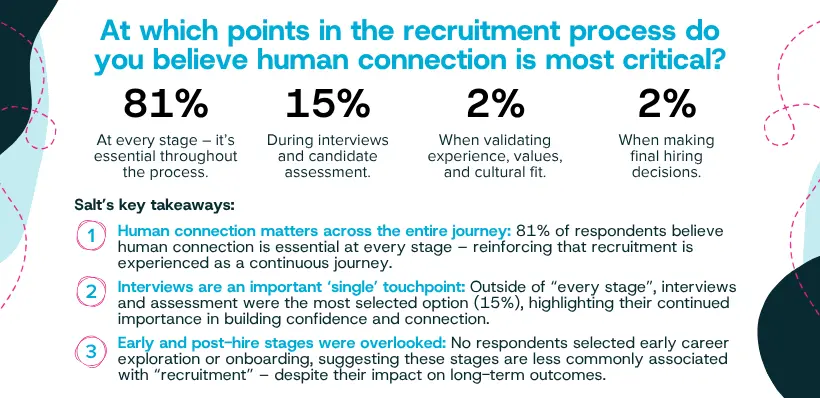
Last month, we asked our client and candidate community where human connection matters most in the recruitment process, and I’d like to thank everyone who took the time to share their perspective. The responses were thoughtful and consistent: an overwhelming 81% of respondents said human connection is essential at every stage of the recruitment journey – a view we strongly agree with.
Recruitment is a journey, not a series of steps
What the results tell me most immediately is that while we often describe recruitment in terms of individual steps – sourcing, interviewing, validating experience and fit, onboarding – people experience it as one continuous journey. And when something is experienced as a journey rather than a series of steps, consistency matters.
Perhaps that’s why such a significant majority see human connection as essential throughout. Recruitment on both sides of the equation is, at its core, a human experience – one that involves judgment, vulnerability, decision-making, and risk on both sides. In that context, trust becomes central.
Why trust matters
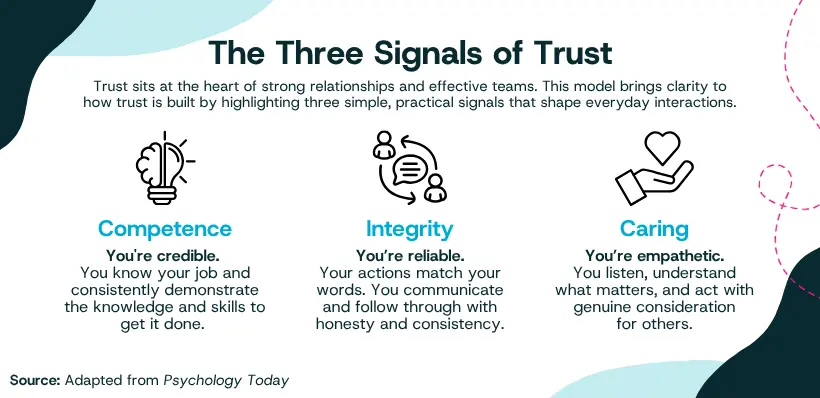
Trust isn’t built in a single moment. It’s built gradually, through respectful, thoughtful, and human interactions over time. It’s built not through isolated interactions, but through multiple touchpoints and consistent engagement. We often instinctively think about trust in terms of three simple signals – competence, integrity, and care – that are reinforced in every conversation, decision, and commitment we make.
The role of human judgment
Recognising potential, understanding motivation, assessing capability, and representing an organisation that’s growing its team takes a deeper understanding than a job description or a CV can ever provide. While AI and other emerging technologies continue to support efficiency across many parts of the hiring process, reading subtle cues, building genuine rapport, and exercising sound judgment still depend on human empathy and experience.
AI can open doors. But it’s people who help others walk through them.
A recruiter can hear hesitation in a voice, pick up on humour, sense confidence, and recognise when someone might thrive – or struggle – in a new environment. Data can highlight patterns and signals, but it takes human skills and experience to interpret them with context and understanding.
Human to human
When candidates feel heard, supported, and well-prepared, they’re more likely to stay engaged throughout the process and to be open about their strengths, challenges, and aspirations. In turn, hiring managers gain a clearer understanding of the person behind the CV – supported by meaningful market insights, honest feedback, and thoughtful guidance – leading to stronger matches, more engaged teams, and better long-term outcomes.
For both candidates and clients, the recruitment process is often complex, deeply personal, and tied to significant professional, financial, and reputational investment. In that context, feeling confident that you’re operating within a relationship built on competence, integrity, and care is non-negotiable. Without trust, recruitment can quickly become transactional. And no individual – on either side of the process – wants to feel reduced to a transaction.
Ultimately, excellent recruitment isn’t simply about facilitating transactions. It’s about people supporting people through complex, personal career decisions – with care, perspective, and accountability. In an increasingly digital world, those human qualities matter more than ever.
Recruitment may continue to evolve through technology, automation, and AI, but it remains fundamentally human. The tools we use may change, yet trust, empathy, judgment, and genuine human connection will continue to shape the decisions that matter most.