What’s Shaping Work: Trust is built through clarity
In this What’s Shaping Work article, Jacqui Barratt, Founder and CEO of Salt APAC, reflects on the relationship between trust and clarity in the hiring process. Jacqui explains how honest communication, transparent processes, and clear expectations create confidence, strengthen alignment, and build trust over time.

In What’s Shaping Work, Jacqui Barratt, Founder and CEO of Salt APAC, shares practical observations on the people, leadership, and workforce challenges shaping organisations across APAC. Drawing on more than 30 years of experience navigating the evolution of recruitment and the world of work, and conversations with business leaders, HR professionals, hiring managers, and candidates, Jacqui offers frameworks, insights, and practical questions designed to help organisations make better people decisions. Every article reflects real experiences, real conversations, and the belief that while technology can support better decisions, human judgment remains essential.
As we approach the end of the first quarter, many of us are taking a moment to reflect on what’s working, what’s changing, and how best to show up in an environment defined by uncertainty and evolving expectations. With Easter presenting a natural moment for many across the region to pause, it’s a timely opportunity to consider what we’ve learned so far this year.
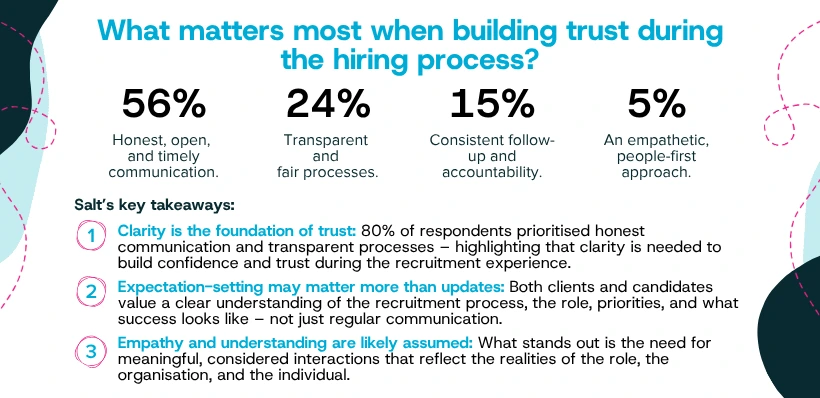
Last month, we asked our client and candidate community what matters most when building trust during the hiring process. The strongest response – with 56% of respondents selecting honest communication, followed by 24% selecting transparent processes – wasn’t surprising. The most interesting takeaway for me is that trust isn’t built through process alone, or simply by being responsive or fair.
With over 80% of responses pointing to honest communication and transparent processes, it’s apparent that we’re talking about more than just keeping people updated – we’re talking about clarity.
Why clarity matters
Clarity means being clear, direct, and transparent about what’s happening throughout the hiring process. Clarity also means setting expectations, defining what matters, and making the implicit explicit from the outset, to help candidates understand what a role really involves, what success looks like, and where the challenges and opportunities lie.
When this level of clarity is present, conversations become more meaningful, alignment happens earlier, and there are fewer surprises – not just during the hiring process, but well beyond it. Early clarity improves outcomes, but the reverse is also true. A lack of clarity creates risk. When expectations are vague or assumed, there is more room for misinterpretation, misalignment, and ultimately, poor outcomes on both sides.
Where clarity starts
This is why taking the time to define a role properly matters. Not simply replicating what the individual in the role has been doing, but pausing to consider what your business actually needs now and will need in the future, how the role will evolve – especially as AI and emerging technologies begin reshaping roles across all industries – and what skills and capabilities will drive success.
Undertaking this process also means moving beyond surface indicators like years of experience or qualifications, and instead focusing on skills, competencies, and behaviours – including things often described as “attitude,” such as willingness to learn, adaptability, and positive energy.
The good, the bad, and the ugly
It also means being clear about what success looks like at 3, 6, and 12 months – and being honest about both the opportunities and the challenges within the role and the broader organisation.
There is no perfect job, no perfect candidate, and no perfect organisation. Therefore, clarity on the good, the bad, and sometimes, most importantly, the ugly reduces ambiguity, strengthens alignment, and creates a more meaningful, two-way hiring process.
Trust isn’t built through process alone. It’s built through clarity – clarity about expectations, priorities, opportunities, challenges, and what success looks like. When organisations invest the time to create that clarity upfront, they create the foundation for stronger relationships, better decisions, and better outcomes for everyone involved.