Navigating digital transformation and AI in e-commerce with Ankit Jadav
Ankit Jadav, Global Head of Digital Operations at Portmeirion Group, shares how starting his career with no budget and no safety net shaped a leadership style built on technical grounding, commercial fluency and people skills.
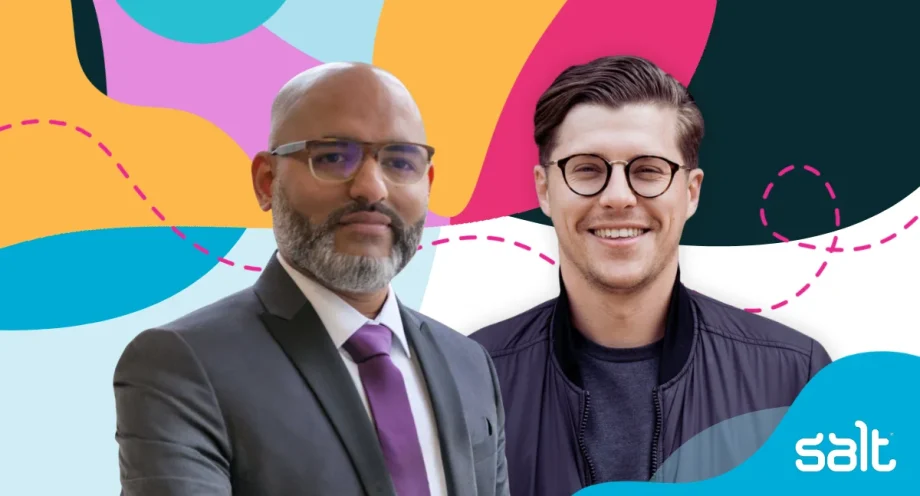
In this edition of Midlands Mentors, Salt Solution’s Group UK & EMEA Director, Tim Bradley, speaks with Ankit Jadav, Global Head of Digital Operations at Portmeirion Group, about the ground-up start that shaped his approach to technology, and why leadership still comes down to people, not platforms.
Ankit’s path into digital leadership and digital transformation wasn’t a straight line through enterprise systems and big budgets-it started with none of either. That constraint became his training ground, and it still shapes how he leads today: from the three traits he looks for in digital leaders to a multi-year tech consolidation now setting up Portmeirion’s next phase of AI-driven personalisation.
Looking for digital marketing experts in the Midlands? Connect with Tim Bradley on LinkedInFrom FrontPage to the front line
Ankit’s fascination with technology started long before his career began. At school, he was drawn to Microsoft FrontPage, “being a geek that I was,” he says, playing with layout, centering images, and adding backgrounds. Later, Adobe Dreamweaver took it further, letting him see the effect of his changes instantly. “That got me even more excited.” From there, transactional websites, CMS changes, and the mechanics of the customer journey became “a beautiful thing to see.”
His first role put that curiosity to the test. Working in a five-person team in Nottingham, “there were no enterprise tools, no agency support, no budget to speak of.” With no safety net, every problem had to be solved from scratch.
That gave him something formal training rarely does: a real understanding of how an e-commerce operation runs. It also shaped how he thinks about expertise itself, not as mastery, but as knowing enough to hold your ground.
“You want to know enough about something to be dangerous.”
For Ankit, that means fluency in code and systems architecture isn’t optional, even in a leadership role. It’s what stops suppliers and agencies from pulling the wool over your eyes: “If you know about code, you know about the system architectures; then when you’re talking to your SIs, they can’t pull the wool over your eyes.”
The three traits of digital leadership
Ask Ankit what it takes to actually lead a digital team, not just run one, and he doesn’t hesitate.
“It’s technical, commercial, interpersonal. You need to have those three traits.”
The commercial piece goes beyond website KPIs, into P&L, vendor relationships and margins. But it’s the interpersonal side he’s quickest to flag as the one people underestimate. “You could be technically minded, but if you’re put in front of a group of business leaders and you’re not able to convey your idea in the way that they would understand, you’re no good.”
Leadership itself, he says, isn’t about having every answer: “you don’t wanna be the know-it-all, because that’s not what you’re there for.” The job is holding the bigger vision while the team delivers against it. Staying organised underpins all of it: Ankit is a committed believer in the Pomodoro Technique, working in focused 25-minute bursts with five-minute breaks. “If you allow yourself the time and the space to work on whatever you’re doing, take a bit of space, come back to it, you will get better at what you’re doing.”
Consolidating the stack, then unlocking the data
Portmeirion Group runs five D2C websites across six brands, including Portmeirion, Spode and Nambe, spanning UK and North American markets, each with its own compliance demands, from PCI DSS to accessibility standards that carry real legal risk if missed. Behind the scenes, Ankit’s team has spent the past three years bringing order to that complexity.
“We are in this three-year period right now where we consolidated our tech, so it’s streamlined.”
That groundwork recently reached a milestone: a first-party customer data platform (CDP), bringing years of scattered customer data into one place. “Now it’s the case of now that we have the customer data… it’s what do we do with it now and how do we unlock those little valuable nuggets that we have had all these years?”
The ambition is real-time personalisation: a customer arriving via organic search seeing a different homepage, different banners and different recommendations to one arriving via PPC, or a returning customer versus someone from an email campaign. It’s not live yet. “Getting to that point is a great deal of work, and we haven’t implemented that strategy yet. It’s [on] a roadmap, but it’s happening very soon.” For Ankit, the CDP wasn’t the finish line; it was what had to happen before the AI-driven experience could even be attempted.
Looking further out, he’s also watching augmented reality make a comeback alongside AI, picturing a customer previewing tableware on their own dining table before buying. “I would like to bring back as well… if you’re sat on your dining table, well, I want my dining table to look X, Y, and Z… you’ve got a couple of plates, hey, you know what it would look like. Go purchase.”
AI is only as good as what you know
That roadmap is exactly why Ankit is clear-eyed about AI’s limits as well as its promise.
“The inputs that you put into AI are as good as what you know. It will not challenge you.”
The trap, as he sees it, is reaching for AI before doing the thinking. “A lot of use cases where people tend to just put their problems willy-nilly into AI tools without going through that creative thinking.” Used well, the upside is real: he points to a task that “was going to take you six hours or however long” being done in 30 minutes once the right creative approach meets the right tool.
His test for anyone talking up AI in the abstract is blunt: “What use cases have you solved?” Using AI “as the hammer to crack a nail of your problem,” he says, isn’t a use case worth bragging about.
Why the Midlands needs to get louder
Ankit is direct about a gap closing faster than it’s being filled: experienced digital talent retiring out of the market. His answer isn’t more senior hiring. It’s visibility.
“When I was in university, I didn’t know NEXT existed in Leicester.”
He points to businesses like Ashbourne-based Boobydoo, known for bra fitting and bra education, as an example of exactly the kind of hidden local opportunity graduates never hear about. For him, the fix comes down to proximity: closer relationships between local businesses and universities, and giving graduates and apprentices early exposure, shadowing, tutorials, and real conversations about what’s being built in their own region.
From the recruiting side, he’s also candid about what’s missing from a lot of graduate CVs: “The interpersonal skills are lacking,” he says, “not through their fault,” but a gap worth naming. Technical knowledge gets a candidate in the room; the ability to hold a conversation with confidence is what keeps them there.
That same appetite for staying close to the work extends to how he thinks about his own development. Mentorship, for Ankit, isn’t a nice-to-have. “Once you stop learning, you start going backwards.”
What stands out from this conversation is how little of it is actually about AI, even though AI comes up constantly. Ankit keeps returning to fundamentals: consolidate before you personalise, know your systems, know your people, and never let a tool replace your own creative thinking.
It’s a grounded, practical account of digital transformation in progress-real infrastructure, built in stages, for real customers across two continents.
Tim Bradley, Practice Director & Host of Midlands Mentors